HelpMeOut: A Neuropsychology-Grounded Benchmark for Error-Aware Monitoring of Household Task Execution
Household benchmarks ask what a person wants to do. HelpMeOut asks whether their ongoing execution is going wrong, when, and how.
Monitoring, one step at a time
A monitor sees the task, the initial scene, and the actions so far, never the future. After every step it must say whether an error has occurred, whether it happens at this step, and which kinds of error have appeared. Step through an instant-coffee episode.
Four questions, four metrics
Each metric isolates one part of the monitoring problem, so a single accuracy number cannot hide where a method fails.
Whether
Trajectory-level discrimination: does this episode contain an error?
Where
Step-level detection: is the error happening at this step?
When
First-alarm timing: is the first alarm early, on target, late, or missing?
What kind
Error-type diagnosis over the nine categories, accumulated over the episode.
Nine kinds of everyday-action error
The categories follow clinical studies of everyday action (NAT / MLAT). Every errorful trajectory stays physically executable: the person can carry out each action, but the execution is wrong for the task.
Progression-level
Break the structure or order of the task.
Current-action
Corrupt the choice of object, tool, location, or action.
The benchmark
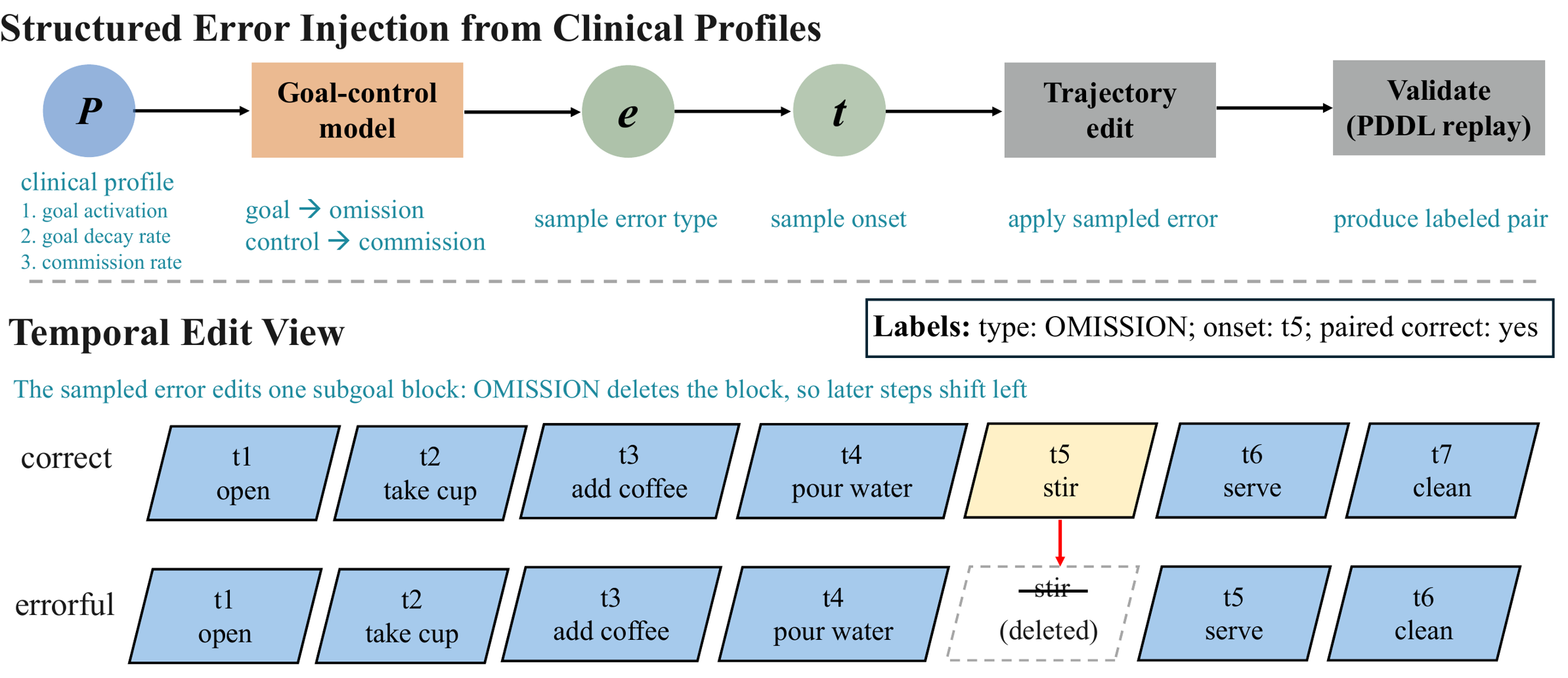
A symbolic household domain turns ADL / IADL routines into paired correct and errorful episodes, with error rates calibrated to clinical populations.
Citation
@inproceedings{wang2026helpmeout,
  title     = {HelpMeOut: A Neuropsychology-Grounded Benchmark for Error-Aware Monitoring of Household Task Execution},
  author    = {Wang, Haoran and Huang, Jingwei and Duan, Anqing and Ahn, Ho Seok and Macdonald, Bruce},
  booktitle = {Conference on Robot Learning (CoRL)},
  year      = {2026}
}